Sunday, March 1, 2020

The Sino-German Cooperation

A veteran ordnance mechanic told me that during the war times, they always admired how their young engineers could communicate with German consultants in fluent Deutsch; I know why, since my dad was one of these engineers.  In 1926 the Chinese centre government starts a Sino-German military and industrial cooperation initiative aimed at resisting Japanese encroachment.  At the time, China was fraught with factional warlordism and western incursions, while Germany under the hostile Treaty of Versailles needed the injection of funds and tungsten, antimony from China.  In 1927-38 totally four inactive German generals and 135 consultants arrived China for modernizing its armed forces and defense production.      The intense cooperation lasted only until the start of the Second Sino-Japanese War in 1937.  Besides the forerunner Max Bauer, Gen. Hans Von Seeckt and Alexander Von Falkenhausen were important figures. Von Seeckt proposed (陸軍改革建議書) 60 divisions reformed as the German Eliteheer, and Von Falkenhaisen made it partially materialized.

When the war erupted, only 20 Reformed Divisions (調整師) were quasi-combat-ready, instead of 60 planned.  China could not afford making them fully German equipped, the elite 88th, 87th, 67th, 57th, 36th, 25th, 14th, 11th etc. RDs were basically provided with Chinese made Mausser 98K (Type-25) riffles, ZB-26 (Type-26) light machine guns, and Germany made MP-18 submachineguns.  The German advisers engaged in the army reorganization and laid a concrete foundation for the doctrine, training, equipment, and tactics of the Chinese army.  And this cooperation nevertheless had a profound effect on the modernization of China and its ability to resist the Japanese during the war.

Lacking firepower, the Chinese soldiers emphasized suicidal hand to hand combat.  Their Type-25 riffle, which was shorter than the Arisaka Type-38, was equipped with elongated bayonet for this purpose.  As per the Imperial Japanese Army 6th Reg/3rd Div’s history, the RD’s men showed high morale, well equipped, familiar with light weapons, hand grenades, and always determined to attack in offensive.  When in the defensive, they skillfully utilized rice paddies, buildings, or cemetery to form strongholds with effective crossfire and flank coverage.  They were ferocious night fighters, launched attacks at 300-400 meters away, tossed hand grenades from 50 meters, and pressed on until the last men.  Under pressure of its new Axis ally Japan, in 1938-41 Germany ended its support for China.


Saturday, February 1, 2020

Eurasia Aviation Corporation (歐亞航空公司)

In 1937 the German ambassador to China requested the Reichslufthahrtministerium to assigned a latest Ju-52/3m transport to the Eurasia Fluggesellschaft, as an answer to the upcoming Ford Tri-motor ordered by its competitor, Chinese National Air Corporation.  Eurasia was a subsidiary of the Lufthansa, it was founded in 1935 under the agreement with the Chinese government.  In September an ex-Lufthansa Ju-52 tri-motor, s/n D-ABAN, was ferried to Shanghai via Guangzhou.  Instead of being transferred to the Eurasia, it became the VIP transport for the Generalissimo, bearing the Chinese Air Force insignia.  Totally 10 Iron Annies had flown with the struggling Eurasia until 1945.

During 1935-37, the Eurasia received the first 7 Ju-52 Iron Annies, nicknamed Big Junkers by Chinese.  Subsequently series numbers 15, 17, 19, 20, and 22 were all destroyed by the advancing Japanese.  The 17 first felt victim by Japanese bombs at Nanking in Aug 1937.  Though restored by Eurasia, but eventually it was blasted out at Hanzhong in May 1939.  In Jan 1938 the 20 was badly bombed in Henan, it took a whole year to be fully repaired.  In May s/n 15 narrowly evaded the fire of three Japanese fighters off coast of Hong Kong, it was attacked again over home base Kunming in Apr 1939.  In the same month the 19 forced landed en route to Kunming from Vietnam, when 3 enemy bombers turned up to it with machine gun fire.  After an urgent repair by the Eurasia ground crews, it perilously took off on a hillside temporary run way.  Amid the advancing enemy offensive, s/n 25 was shot down and three more crashed.  At the time, one of the German speaking, busy aeromechanic was Mr. Shao (紹高典), a graduate from Tongji, the sole German founded university in China, and a future buddy of my dad in the Taiwan Aluminum Corporation.

In February 1938 Hitler began to unilaterally terminate all the China assistance to please Japan.  Though the shortage of both aircraft and supplies had been a series blow to Eurasia, still on April 2, 1940, the 17 ‘Langzhou’ started flying between Chongqing and Hami (Kamul) as well the China-Russia civil line.  On 28 April, Göring officially called a halt to German export shipments through to China.  Yet again, additional 3 ex-Lufthansa Ju-52s re-enforced the Eurasia in August 1940.  But right before they entered service, the 25 was shot down by Jap fighters.  In December the 20 was once more an air raid wreckage in Chengdu, soon the 15 was also blasted in Gueiling.  With its fleet was about worn out and operations ceased in 1943, the hard-pressed Eurasia claimed bankrupts.  Its tiny flight of 1 Junkers W-34 and 1 Ju-52 were incorporated in to CNAC.  But the latter, the 19, was scrapped in 1945.


Sunday, October 13, 2019

Mechanical Themes Woven Into Stories (各出所學 各盡所知)

Before the US Military Assistance Advisory Group withdrawal from Taiwan in December of 1978, my father Wei-Liang Lee (李惟梁), with his multicultural and technical expertise, was one of the few industry leaders the US advisers could rely on for assistance and allyship.  As the general manager of Taiwan Aluminum Corporation, W.L. was not only the top-flight mechanical-metallurgical engineer in Taiwan, but also a known indigenous sustainability advocate.  Although he had the idea for local production of the M-113 armored personnel carrier, he needed the specifications for its aluminum armor plate.  To ensure its own dominance in the region, the US discouraged Taiwan from making its own heavy equipment.  However, amateur diplomat W.L. managed to acquire the M-113 manual with the magnesium aluminum alloy spec through the proper channels.  Worded as a subtle technical transfer under the benign eye of a American friend, W.L. jumped at his M-113 APC project. 

Applying his knowledge, W.L. successfully developed the highest strength aluminum, and the new aircraft-quality alloy was fitted into his Talco strategy of added-value products.  As per the 113 spec, its armor is made from the 5083 super alloy.  My dad still needed a tactical hardness test from the US Army to compare the Talco product and 5083, while the US was reluctant to test this Taiwanese material.  Delayed by the US apprehension, fortunately the chief of the ROC purchase contingent to Washington lent a hand, since Gen. Wen Ha-Xong (溫哈雄) also regarded charismatic W.L. as a decent friend.  In the two years long effort, Gen. Wen made the US Army release its test result.

According to the 113 requirements, its armor should resist certain projectiles from various impact angles.  Though the Talco product fulfilled 97% of the requirement, it qualified for the standard on the reasonable merit.  This achievement provided a solid foundation for the Combined Logistics Command’s “Ten Thousand Chariots Program (萬乘計劃)”, for domestic M-113 production.  W.L. lost no time on 5083 mass production right after Talco received DOD’s 113 armor orders.  All the first batch of 60 then 250 more vehicle materials passed the Army’s inspection before 1985.  Based on its maintenance experience on steel chassis, the Armoured Vehicle Development Center did not have an argon welder for aluminum alloy.  Soon after the argon welding training by Talco instructors, the AVDC began churning out hundreds of 113s.


Sunday, September 1, 2019

Nothing Comes Without a Cost

From the imported MiG-9 jet of 1950, to the national pride of indigenous stealth fighters via copied Russian types cross millennium, Chinese aviation engineers worked all their lives to get where they are today.  Since its first successful MiG-17 copy (Re-designated J-5) in 1956, nearly 10,000 aircraft churned out under dozens of designations.  This industrialization is achieved through a long struggling, its success have eventually outperformed the grotesque neighbor on measures of defense might.  Especially right after the Sino-Vietnamese War in 1979, its air power modernization changed from flying artillery to air superiority dominance. 

When China proudly unveils its KJ-200, KJ-2000 J-10, J-11, and J-15 in dazzling Zhuhai 2016 and previous air shows, there were several unsuccessful projects, namely, J-8, J-9, J-12 and J-13 etc. were aborted.  Though these designs became obsolete even before accomplished, they laid the foundation of the integral development of the overall aviation industry.  After its Maoist-fueled isolationism sentiment diminished in 1978, Grumman joined the Shenyang Aircraft Corp. (Plant 112)'s J-8 project under the code Engineering 82 in 1986.  In this unparalleled 14 years R&D, it's rival, Chengdu Aircraft Industry Corp. (Plant 132)'s J-10 project surpassed J-8 by a decade, soon the CAIC was chosen to produce Boeing 757's empennage and MD-80/9o's nose section.

China has the ability of have a coherent conversation and achieve consensus, on topics of national importance, then real progress become possible.  Unlike this longing for self-sustainability, Taiwan heads big-ticket weaponry purchase in an apparently misguided attempt to pay its protection fee to the US.  In a standoff air combat, the J-11 with ZHUK-M radar can easily outclass both Taiwanese Mirage 2000-5 with Mica missile, and F-16MLR with AIM-120 missile; let along the superb maneuverable J-15 in dog fight.  Lucky for the intentionally blinded Taiwanese not falling on this issue.  Across the Taiwan Strait, the historical march toward a more stable and less violent era continues, but not without chilly times ahead for the island state.


Thursday, July 18, 2013

Float the Political Boat

No airlines in Taiwan in the 1950s-whether they celebrate or resent it-can escape the CIA shadow.  With the CIA investment in 1951, the Civil Air Transport, Inc. was expanded to 10 C-46s, two C-47s, and four Cessna 195s from a stressed fleet.  In 1959 its special operation branch became the Air America.  After the CIA and Taiwan backing Anti-Sukano Permista guerrilla failed in Indonesia, loads of supplied were diverted to India by CAT to support Tibetan revolt.  Mar 30, the CIA trained Khampa guerrillas also failed, Dalai Lama and his 600 retinue fled to India with the help of the CIA’s Special Activities Division.

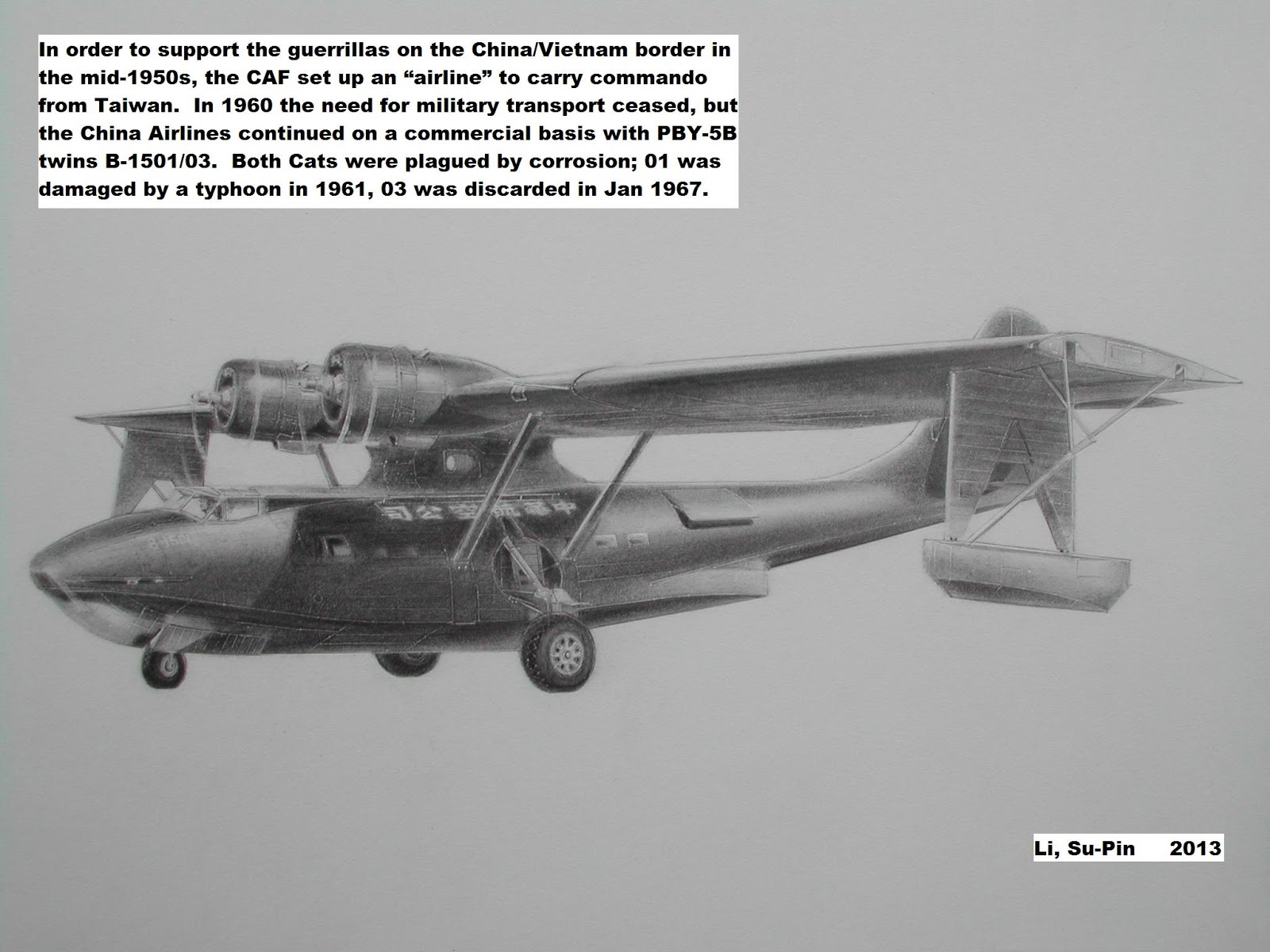
Yet the success of its DC-4 and DC-6 fleet, the CAT’s sole Boeing 727 jetliner crashed before landing at Taipei on Feb 16, 1968.  Weakened by declining CIA activity, beset with the B-908 (C-46-CU) and B-1018 (B-727) disasters, the Civil Aeronautics Administration took steps to distance CAT from Taiwan.  Soon the China Airlines with just two PBY-5Bs replace it as the ROC’s flag carrier.  Meanwhile, another Catalina twin of the TransAsia (Foshing) Airways hired out to the Defense Ministry, and frequently to Matsu and Dongyin outpost, HQ of the tight secret Anti-Communist Salvation Army.  Eventually this air charter turned out to be the life line of TNA, during the Cold War and ACSA’s hopeless fighting over a hollow ideology.

As a Hump veteran and VP of the China National Aviation Corporation, Moon Fun Chin went to Taiwan after the CNAC and CATC defected to the Communist China.  With two PBYs worth US$40,000, Chin found the TNA on May 2, 1951.  In the early retrocession days in Taiwan, air traveling was wildly unaffordable, the startup then became a military charter for survival.  Jun 27, 1955, his B-1402 “Blue Swan” with a CIA passenger onboard, closely escaped a MiG-15 predator, nonetheless it reached safety at Songshan airport.  Oct 1, 1958, Taipei-bound 02 took off at 1745 from Matsu, with four crewmen, three officers of the Penghu Defense Command, and four CIA agents onboard.  Proceeded on a 130° course at 1000’, 80 nm from TPE, it made a last contact at 1810, then blasted by a MiG-17 and lost without a trace.  After this sinister loss, TransAsia ceased to trade.


Wednesday, June 12, 2013

China Airlines in Action

Under the code name Southern Star (南星計畫), the China Airlines Ltd. and its CAF counterpart Black Bat Sqn. had conducted a special warfare over North Vietnam for 14 years.  In 1960 the president of Republic of Vietnam Ngo Dinh Diem requested a military cooperation with ROC, and triggered a long CAL clandestine operation in Vietnam War under the ROC Military Assistance Advisory Group.

The CAL started in Dec 1959; its twin PBY Catalinas, 26 staff and few support equipments all came from its big brother CAF.  In struggling, the new startup joined Vietnam War for cash flow via international alliance.  With a strict engagement ban over north latitude 17° imposed on the USAAF, the US asked ROC to take over the secret airdrop into North Vietnam.  Using two mothballed CAF’s C-46s with newly-purchased R-2800 engines installed, the CAL launched its Southern Star No.1 in 1962-63.  During a prolonged overflight for identifying drop zone, a C-46 exposed its course to the Vietnam People’s Army.  This DZ info leaks caused the second Commando shot down in the next sortie, all its crews killed.

South Star No.1 merged into No.2 then 3, its profit began beefing up CAL’s vigor, the buildup was the arrival of Douglas DC-4/C-54, Lockheed L-1049, Nihon Aircraft YS-11, Boeing B-727, etc.  But their baptism of fire was costly, 14 aircraft lost and 49 crewmen perished.  30 Apr, 1975, the last CAL charter plane arrived Tan Son Nhat airport for urgent evacuation, ground crews must removed the cabin seats to squeeze all the panic ROC aliens.  Under the VPA crossfire and bullets riddled the empennage, the overloaded transport took into the Saigon air by its war-hardened pilots.  Soon after the ROV capital was renamed Ho Chi Minh City.

Sunday, April 14, 2013

Texan in a Desert Storm

From the 1930s Xinjiang Province in western China was under escalating USSR intervention, which resulted in a short-lived Russian-backed East Turkestan Republic (ETR) began as a Muslin rebellion (伊寧事變) at Ili, Tarbaghatai and Altai in late 1944.  Aimed at preventing more massacre to the ethnic Chinese by the Uighur, Kazakh and White Russian soldiers, the Central Aviation Committee set up a North American Detachment equipped with armed AT-6Ds in support of the advancing army.  This was the first close-in anti-insurgency operation by the CAF trainer fleet.

To have much hope alleviate remote desert, any redoubled effort from the impoverished China needed Western help, e.g. the Eurasia (a subsidiary of the Lufthansa) Ju-52 tri-motor’s regular flight to Kumul since 1935.  Though the struggle the Nationalists centre offering add up to a credible operation, but Stalin tend to progress in unexpected ways under Mao’s “New China”.  Merely the tip of an iceberg, the ETR was omen of a much worse Soviet ambition to split China.

Under the PROC, Outer Mongolia was erased from the Chinese map on Oct 1, 1949, in collaboration with this area was annexed by USSR.  Feb 14, 1950, Mao and Stalin signed the inequitable Sino-Soviet Treaty of Friendship, Alliance and Mutual Assistance, in Moscow Mao declared unconditionally supporting Mongol separation.  At this pivotal point of division of China, by comparison the PROC spiral into turmoil, the ROC in Taiwan enjoyed some unanticipated peace.  Its trainer asset still used the line of North American, namely AT-6 Texan, AT-16 Harvard IIB and top-of-the-line T-28 Trojan.